





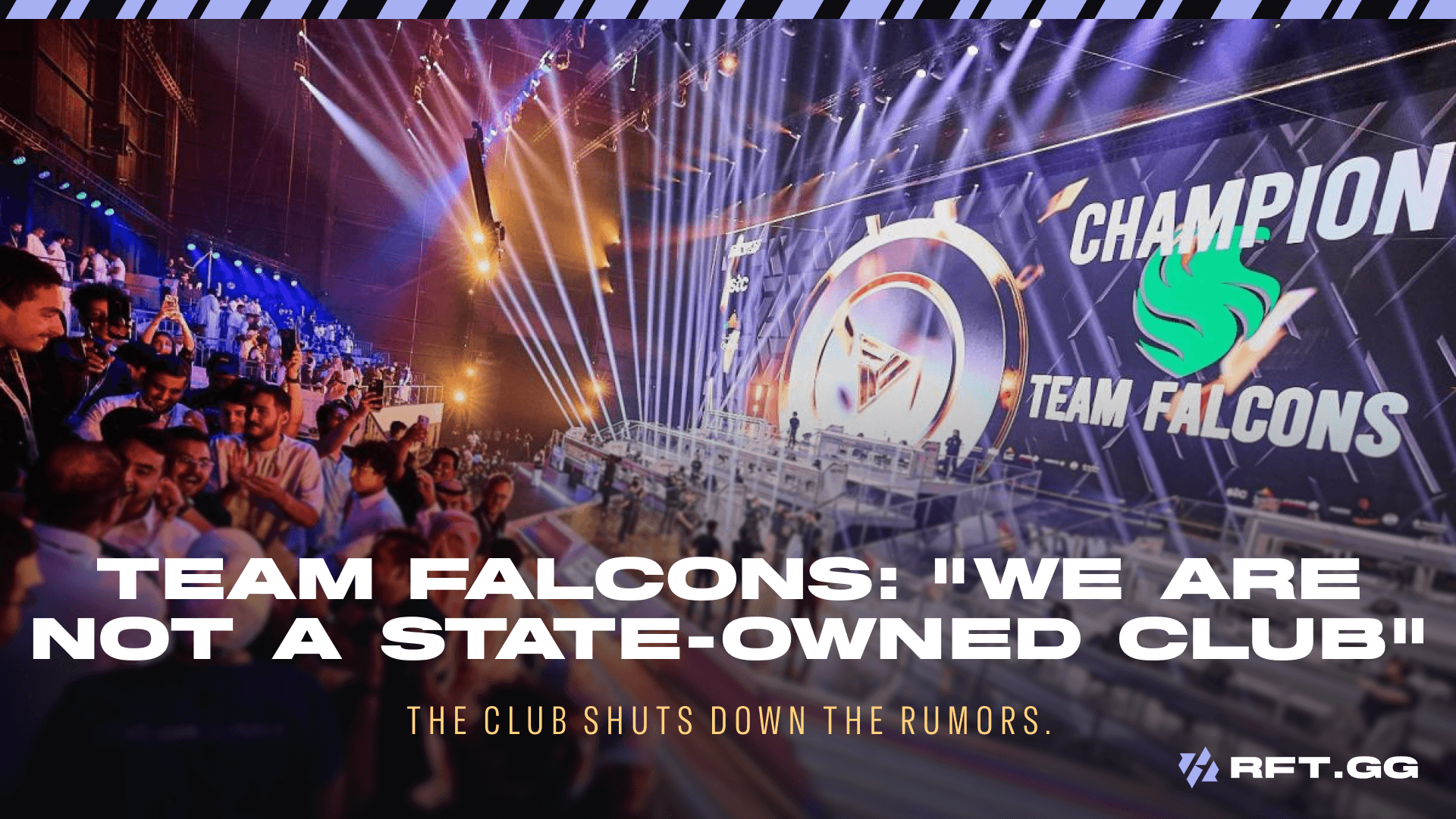
Jordan Savelli, French sporting director of Team Falcons for the past year, opens up in a lengthy interview with L'Équipe where he details the inner workings of the Saudi organization, which has become a dominant force in global esports. Breakdown.
Falcons is not funded by the Saudi sovereign wealth fund
This is the heart of the article. Savelli states unambiguously that the PIF (Public Investment Fund) is not behind Falcons:
"To be honest, it would be much simpler if the PIF were with us, but that's not the case."
He acknowledges, however, that the Saudi royal family is "huge" and that it is possible the founder Msdossary received help from one of its members early on, but he insists: "Falcons is not a state club." The article nonetheless notes that some of the club's sponsors, past and present, are directly state-owned (Saudi Telecom Company, NEOM), a situation that could hardly be called exceptional in the West, where companies like Orange or Deutsche Telekom also have the state as a shareholder.
The club operates with a substantial but structured budget, "there is no unlimited credit card". Largely fueled by regional sponsorships, where the Falcons brand is extremely powerful across the Middle East. The EWC winnings (a minimum of $7 million for the winner) are largely reinvested into the rosters.
The LEC and Riot Games episode
Savelli is very straightforward on the League of Legends topic. Falcons tried two years in a row to enter the LEC. The first time, for Astralis' slot, with negotiations around 20 million euros, but the club lost out to Karmine Corp. The second time, for Rogue's spot at an estimated price of 12 million, which held Falcons back from investing this time:
"That doesn't give a good indicator for your league. Am I going to put in 12 million if, in two years, they might only be worth 6?"


- Orange = ~20% French state - Telekom = ~30% German state - Stc = ~64% Saudi Arabia via PIF - NEOM = 100% Saudi Arabia via PIF If this french guy relies on false equivalences to prove a point, the Saudis should fire him from Falcons, he's an intellectual fraud and a liability to their business. Thankfully they won't because he's a useful fool, a traitor to his country by participating in a foreign state propaganda.
Chill out, in France for example we have La Banque Postale which sponsors teams and leagues and is 100% publicly owned. The point here is to note that this situation involving public sponsors does exist, but that it does not automatically imply any influence outside of esports