




The Korean esport association published a 150-page study on February 20 examining the economic impact of esport in South Korea. Behind the record figures put forward lies an open political case for tax reforms and inclusion in the Sports Toto system.
The Korea e-Sports Association (KeSPA) is the longstanding governing body of South Korean esport. Founded in 2000, it marks its 25th anniversary under unprecedented circumstances. Its audited accounts for fiscal year 2024 show revenue of approximately $4.9 million, down 24% from 2023, and a net loss of $330,000, a 45% deterioration year-on-year.
Government subsidies remain its primary source of income at $1.95 million (39% of revenue), followed by league management fees ($1.65 million, 33%). In other words, KeSPA is a lean, loss-making organization that no longer holds the LCK Corp, which was absorbed by Riot Games Korea on September 30, 2025.
It is against this backdrop that the association unveiled, on February 20, a study titled "Economic Effects of Esport Tournaments and Measures for Expanding Tax Benefits." The 150-page document was produced in collaboration with game publishers, teams and industry stakeholders, with a clear objective: to demonstrate, figures in hand, that Korean esport generates tangible economic value — and that it deserves greater public support.
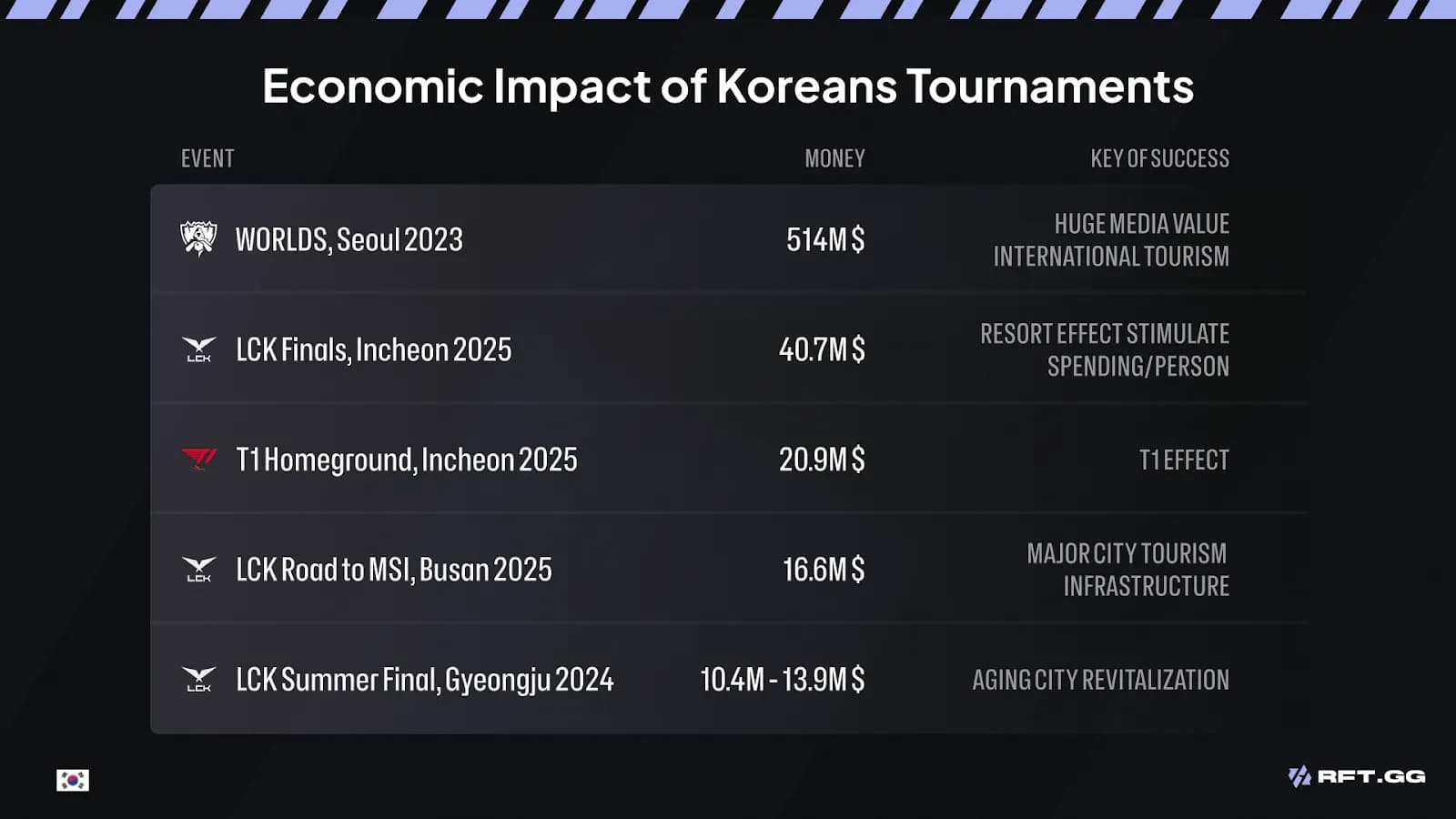
The headline : $514 million for Worlds 2023
According to KeSPA's estimates, the 2023 League of Legends World Championship held in Seoul generated approximately $514 million. That is 3.7 times higher than previous assessments, which placed the event's economic impact between $153 million and $200 million.
The model incorporates a "quantified sponsorship value" broken into two components. The first is media value: sponsor logo exposure time is converted into an equivalent advertising rate, based on hundreds of millions of viewers.
The second component is more unusual. KeSPA adds a "client expansion value," estimating the future revenue generated by new consumers acquired through the event. The concept is borrowed from corporate marketing and is not typically included in standard economic impact studies.